Digital transformation is not a software purchase.
Running a service business without a real ops stack is like racing a Formula 1 car on a bicycle. Your bigger competitors are buying AI, paying consultants, and compounding their edge every quarter, while you’re triangulating post-it notes across six disconnected tools. Digital transformation is how you close that gap. Most founders start it at the wrong end.
Why your competitors are compounding while you’re standing still
If you run a services company and the bigger players in your market have been quietly tooling up for the last three years, you’re not competing on the same terms anymore. They’ve got AI agents fielding inbound calls. They’ve got dashboards linking every client to every invoice to every project. You’ve got Slack, a shared drive, and whatever’s on the whiteboard this week.
That gap widens every month. And the sales pitch you’ll hear from most software vendors, “buy this license, transform your business”, is exactly why most founders burn $50K and end up with the same mess, now with an enterprise login screen on top of it.
Digital transformation is real. It’s also four specific phases, in a specific order. Skip any one of them and the whole thing stalls.
Phase 1, Map the process before you spend a dollar on software
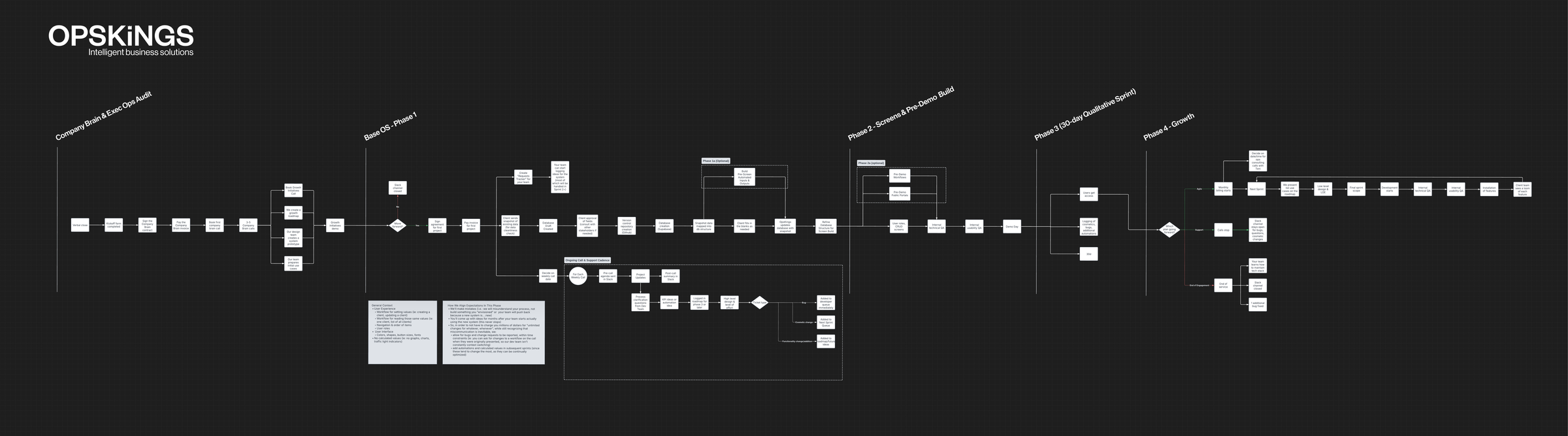
Before you touch a tool, map your entire business end to end. On paper, on a whiteboard, in Lucidchart, the medium doesn’t matter. The output does.
The point isn’t a pretty diagram. The point is you can’t see your bottlenecks until every step is in front of you. The re-entry point where your ops team retypes data into a second system. The approval chain that takes four days because three people have to be pinged manually. The lead that sits in a rep’s inbox for a week because nothing actually handed it off.
Every founder we’ve worked with, pen-and-paper shops up through $30M operators, has opinions about where their bottleneck is. Almost nobody is right until after the map exists.
Phase 2, Build a single source of truth
Once the process is mapped, the next move is putting all your data in one place. One login. One system of record for clients, projects, team members, tasks, invoices, and payments.
This is where the entities conversation starts. An entity is just a thing your business tracks, a client, a job, a payment, an employee. The reason a single source of truth matters is that once those entities live under one roof, you can connect them. A payment links to a client. That client links to three active projects. Those projects link to the team members logging hours against them.
Right now, most of that lives in six tools that don’t talk to each other. QuickBooks knows about the payment. The project tool knows about the hours. Nothing knows about both. That’s the gap Phase 2 closes.
Phase 3, Track the numbers that were invisible before
Once your entities are connected, you can finally measure things you couldn’t before. Project profitability. Average cash cycle. Billable rate per team member. Cost per lead by source. Average days-to-close by rep.
These numbers existed before, they were just buried across spreadsheets nobody had time to cross-reference. Now they’re one click.
This is the quiet phase that changes how you make decisions. Most founders run on vibes because running on data is too expensive to compute manually. After Phase 3, the vibes get replaced. You find out which service line actually makes money. Which client is a margin drag. Which rep closes fast but at a 20% discount. You stop guessing.
Phase 4, Only now does automation and AI make sense
This is the phase everyone wants to skip to. Don’t.
Automation and AI are the cherry on top. A voice agent that handles inbound. A workflow that auto-generates quotes. An AI notetaker that files call summaries against the right client record. They’re genuinely good, when they’re solving a problem you’ve already identified and measured.
The reason this is last is that now you know what to automate and you can tell whether it worked. You’ve got a baseline number. You drop the automation in. You watch the number move. That’s an ROI loop. Without Phases 1 through 3, you’re buying AI tools on vibes and hoping they help.
Phase 4 is where the ROI is huge. Phase 4 without the first three phases is where the budget goes to die.
“Software is the last thing you spend on in a digital transformation — not the first. Most founders get that backwards and pay for it twice.”
The three mistakes that stall most transformations
Almost every failed transformation we’ve walked into has the same three mistakes:
- Delay. Paralysis by analysis. “We got this far without it, we’ll be fine.” You will not. Your competitors are compounding. Waiting another year is a decision.
- Over-analyzing which tool to buy. Founders spend six weeks comparing CRMs before they’ve mapped the process the CRM is supposed to support. You can’t pick the right tool for a process you haven’t drawn.
- Treating software purchases as transformation. Licenses don’t transform businesses. Processes do. Software is the last thing you spend on, not the first.
If you recognize any of those in your own org, the fix is the same: go back to Phase 1. Map first. Everything else follows.
- • Digital transformation is four phases in order: map the process, build a single source of truth, measure what was invisible before, then automate.
- • Buying software first is the most common and most expensive mistake. Software is the last 10% of the work, not the first.
- • Phase 1 is a process map. Pen-and-paper is fine. You can’t automate what you can’t see.
- • Phase 3 is where most founders realize they’ve been running on vibes. Every number that was hidden becomes visible.
- • The three killers: delay, over-analyzing tools, and treating license purchases as transformation.
Want us to map yours?
Book a 30-minute call. We’ll walk through your current process, flag the biggest bottleneck, and sketch what the four phases look like for your business. No pitch if it’s not a fit.